
School Desk and Classroom Furniture Selection Guide: For Schools and Courses
Furnishing a classroom is more than picking a desk from a catalog: a desk at the wrong height ruins a student's posture, a flimsy top wears out within the first term, and a poor layout makes classroom management harder. This guide covers school desk and classroom furniture selection for schools, courses, and study centers with concrete criteria: age group, dimensions, durability, and the bulk purchasing process.
Desk and Seat Heights by Age Group
The first and most critical decision in classroom furniture is sizing. The EN 1729 standard, which governs school furniture dimensions in Europe, numbers desktop and seat heights according to height ranges. The goal is simple: when seated, the student's feet should rest flat on the floor, the elbows should sit close to desktop level, and there should be clearance between the knees and the underside of the top.
- Preschool (height approx. 100-120 cm): desktop height 46-52 cm, seat 26-30 cm
- Primary grades 1-4 (height approx. 120-140 cm): desktop around 58 cm, seat around 34 cm
- Middle school (height approx. 135-160 cm): desktop around 64 cm, seat around 38 cm
- High school and adult courses (height over 160 cm): desktop 70-76 cm, seat 42-46 cm
If the height spread within a class is large, proceeding with a single size matched to the grade level, rather than mixing two consecutive sizes, makes stock and layout management easier. For adult courses, the standard adult size is the only right choice.
Single or Double? The Difference in Layout and Use
Single desks offer the advantages of switching to an exam layout in seconds, regrouping desks for teamwork, and giving every student equal personal space. For courses and study centers that assess with exams, this is usually the first choice.
Double desks fit the same number of students into fewer square meters and lower the cost per seat; in crowded classrooms, space efficiency increases noticeably. The deciding criterion should be how the classroom is actually used: if the layout changes often, single desks win; if the arrangement is fixed, doubles come out ahead.
- Single desk: flexible layout, exam seating, individual space
- Double desk: space efficiency, lower unit cost, fixed arrangement
- Mixed solution: doubles in the front rows, a block of singles at the back that can turn into group-work stations
Course and Study Center Layout: Plan with Measurements
Classroom layout is planned around board visibility and ease of passage. At least 170-200 cm should be left between the first row and the whiteboard; the aisle between desks should not drop below 60 cm. When the service corridor between the wall and the desks is 80-100 cm, the teacher can move around the classroom comfortably.
Classrooms in courses and study centers are usually smaller; here, a U-shaped layout or a straight layout with two-seat blocks provides both eye contact and easy supervision. When determining capacity, roughly 1.5-2 m² of classroom area per person is a realistic starting point.
Durability and Cleaning: Surface, Frame, Details
Classroom furniture is a product touched hundreds of times a day and hit by bags and shoes; material choice must reflect this reality. On the surface, a werzalit or high-pressure laminate top is the wipe-clean standard that resists pen marks and scratches.
- Frame: oven-baked (electrostatic powder-coated) metal profile; weld points should be cleanly finished
- Top edges: PVC edge banding on impact-prone edges, or self-edged werzalit
- Floor contact: plastic feet prevent floor scratches and keep use quiet
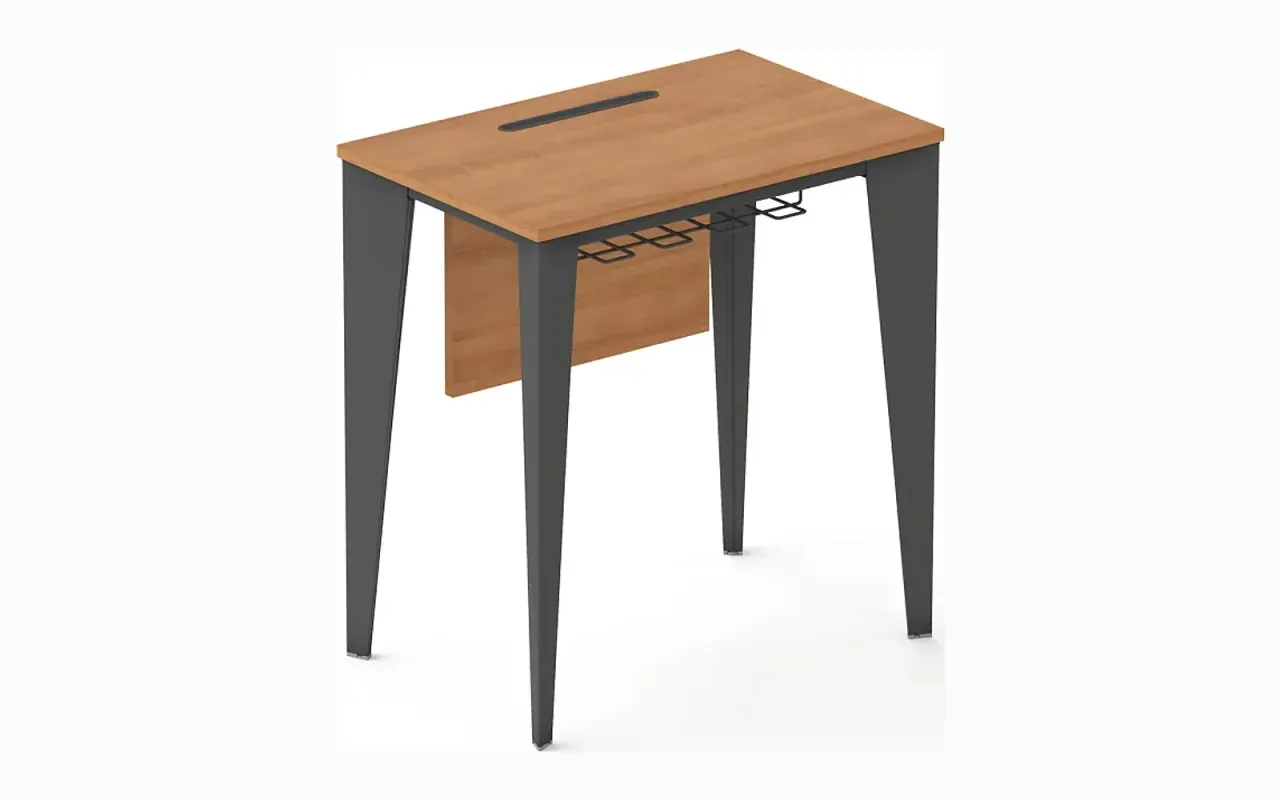
- Daily-use details: a bag hook and an under-top book shelf keep the classroom tidy
On the cleaning side, porous, non-wipeable surfaces should be avoided; on surfaces frequently wiped with disinfectant, melamine and laminate far outlast fabric-covered surfaces.
How Does the Bulk Purchasing Process Work?
Since school and course purchases involve quantity, the process differs from retail shopping: a needs list is drawn up (number of classrooms, grade level, quantities), samples and measurements are verified, and the delivery schedule is planned outside the academic term. Summer break and mid-term breaks are the right window for completing installation without disrupting classes.
Fil Office runs this process as a manufacturer: volume production is planned for school desks and classroom furniture, delivery and assembly within Istanbul are free, and products are delivered with a 2-year factory warranty. Pricing is finalized by quote according to quantity and configuration; you can start the process by sending your needs list.
Frequently Asked Questions
Which size should be chosen for students of different heights in the same classroom?
Proceeding with a single size matched to the grade level's height range is the most practical solution; the EN 1729 size steps are already designed to cover a specific height range. In mixed groups with a very wide height spread, for example adult courses, the standard adult size is preferred.
For a course center, are single desks or writing-tablet chairs the better choice?
If lessons are long and note-taking is heavy, single desks are more comfortable; the top is larger, and a book and a laptop can be used together. Writing-tablet chairs, in turn, save space in flexible rooms where the same hall converts between seminars and lessons.
How are delivery and assembly planned in a bulk purchase?
Once the quantities and the classroom list are finalized, production and delivery are scheduled around the academic calendar, and assembly proceeds classroom by classroom. For school and course projects within Istanbul, Fil Office provides delivery and assembly free of charge.
Looking for the right furniture for your office?
Browse the full catalogue and add your favourites to your quote list.
Explore Products